
On one of the warmest and windiest summer nights in August 2017 as I walked home from Wrigley Field, my phone repeatedly buzzed with updates: “Taylor Swift announces new album reputation out November 10th” and “New Swift single ‘Look What You Made Me Do’ Out Now.” As I received these notifications, I stepped aside and into an alley to play the song for the first time as I processed the unexpected news, how excited I was about it, and how I felt about Swift’s new, unfamiliar, bombastic and seemingly-angry sound. I continued walking home as I tried to understand.
As a more-than-a-decade-long fan of Swift, I had gravitated toward the familiarity and empathy I felt when listening to her music; however, “Look What You Made Me Do” managed to challenge these previous notions of the Taylor that I felt that I “knew.” In the song’s bridge, Swift declares that the “old Taylor can’t come to the phone right now.” I paused in my steps, audibly asking “What?” as Taylor responded “Why? Oh, because she’s dead.” Because she’s dead? But isn’t she singing right now? I replayed the bridge over again to be sure I had not been mistaken, but in just one moment, each of the other versions of Taylor I had known were not only unrecognizable but were non-existent altogether.
Although one of Swift’s strengths as an entertainer and a songwriter is making each the narrative for each of her eras distinct from their predecessors, the strength in reputation comes from narrating the culmination of all of the Old Taylors. This becomes complicated, however, when trying to discern who Swift “really” is versus who she desires the public to think of her to be based on who she has been. Throughout reputation, Swift writes about two versions of herself: a woman in her mid-to-late twenties finding true love after chaos and betrayal, and the media’s depiction of a woman in her mid-to-late twenties that victimizes herself and, because of it, will never know true happiness since her reputation precedes her. Still, reputation was not Swift’s first experience with writing as the character that the media paints her to be. In Swift’s 2014 single “Blank Space” from her album 1989, Swift acknowledged for the first time–and wrote as if she actually was–the manipulative, victimized, serial-dating snake that tabloids insisted she had been all along. In an interview with Katie Atkinson at Billboard, Swift disclosed how “Blank Space” “was the first time [she] had ever used songwriting as a humorous coping mechanism for an overly harsh depiction of [her] in the media,” but that “it wouldn’t be the last.” Because half of the songs on reputation are written from this perspective, and the other half are written about Taylor’s personal world and relationships that tabloids had not yet tapped into, the songs blur these narratives, leaving listeners to discern which songs belong to which Taylor. But in my mind, there was still only one Taylor: she was simply the most present version of herself, with the media’s depictions of her being just a small sliver. Her past selves, albums, and eras were ever-genuine, just as real parts of her, even if they were not prominently evident in the present-day minds of the public.
From age 10 until about 21, I always had felt that Taylor and I, in a way, grew up together. Of course, this was not technically true, but the seasons of her life would pass just as I was about to enter into them. I had always told those closest to me that if I ever had the opportunity to meet Taylor, I would thank her for feeling like an old friend that has grown with me, thank her for writing my favorite [Old Taylor] songs “Long Live” and “Begin Again,” and ask if I can give her a hug. But with every Old Taylor that I knew gone, I felt with confidence that there would never be a possibility of thanking Taylor for being there throughout the years that oftentimes felt vulnerable and confusing. She had always understood, and she would always explain, but for a year prior to reputation, Swift had gone into hiding, making no public appearances and participating in zero interviews. But through her silence, she had made it loud and clear this time: “There will be no further explanation, only reputation.”
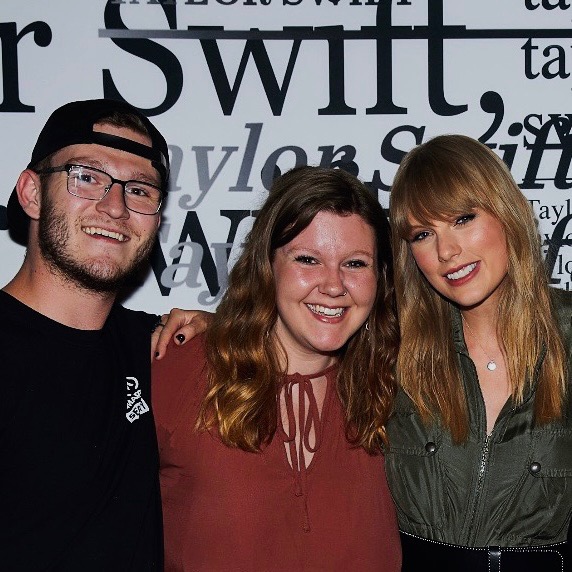
Almost ten months to the day I stood in the alley listening to “Look What You Made Me Do” for the first time, I had been invited to a reputation celebration sponsored by AT&T. Just like reputation itself, there was no explanation. I received an email with an address, and I called off work for the afternoon. After going through security and having our personal belongings taken, my brother and I were bussed to a second location. A venue filled with antiques transformed to a black and white newspaper with Swift’s name plastered on the walls with reputation playing on repeat over the loudspeakers, preventing us from envisioning any other version of who Taylor had been or could be. It was only reputation. That night, Taylor found herself in Chicago too. And in natural Taylor fashion, she also did not provide an explanation, or even a warning. What appeared to be a metallic wall within the warehouse was actually a garage door, opening to a neon-lit, 200-person concert venue where Swift surprised us 15 minutes later. For the first time during the reputation era, Taylor brought attention to the two characters she wrote as: a version of herself that does not care about her reputation and what others say, and the other version that actually cares too much. It was then that I stopped believing that the Old Taylors were dead as all of them stood before me at once.
An hour after singing and laughing together, surrounded by newspaper print and cameras, I had the opportunity to thank Taylor for growing with me, to thank her for writing “Long Live” and “Begin Again,” and to ask if I could give her a hug. There was not a single part about this day in June that I expected. But what I expected least was for Taylor to thank me for being there for her after all this time. She said that, from her monitor backstage, she saw me crying and was excited to hug me and show me that we were wearing the same earrings. She pulled back her hair and, just like me, had two little gold snakes dangling. She shook her head, as if she was embarrassed or that I would be uninterested in this simple joy. It was then that I realized the Taylor that had hid from the world was looking me in the eyes. The Taylor that pushed a lot of people away just pulled me in for a hug. And the Taylor that everyone claimed to not know anymore had never been more familiar or empathetic, and she did not have to explain a thing.
 kaitlyn madden